Hey! A week or so ago I sold an obsolete 3D-printed Jennifer figurine I handpainted! Well, here I am again with a 3D-printed hand-painted Sarah figurine! Why am I getting rid of it? Well, I thought mine should be a little tiny bit taller, so I reprinted her at a slightly larger scale and repainted her, but now I have this 5% smaller Sarah that’s surplus to requirements. So she’s getting auctioned.
Like Jennifer, this Sarah is about 6 inches tall, printed out of PLA plastic, and handpainted by me! You can go bid on her. Auction ends in 4 days.
This one isn't about game design, though. It's not lectures at all -- I promise you are in no danger of learning to do anything in particular. The book is about play as a general concept. A bunch of people from different walks of life, talking about play. How we play; how we create play; where we play; how we learned to play; why we play. And on.
The project sprouted from a series of interviews and questions organized by Drew Davidson. I agreed to talk to Drew, and so did a lot of other people, and this book is the result. "A playful thematic oral history of the stories shared," as the blurb page says.
Like the Kaleidoscope, Ludic Narrans messes with the idea of linearity. Two editions are available: Playing it Straight is organized by topic, whereas Playing Around interleaves topical sections in a playful fugue. Same content, variable structure.
Names you might recognize: Jenova Chen, Naomi Clark, Mia Consalvo, James Ernest, Rami Ismail, Jim Munroe, and no doubt others. And me of course.
Both editions are available as free PDFs. (See the "Download" links on the book pages.) The text is under a Creative Commons license (BY-NC-ND).
Or you can pay for either print or ebook editions at Lulu. Note that each print edition is itself available in two forms. The only difference is the interior illustrations, printed in color or monochrome. (They're nice illustrations but I wouldn't call them central to the book's presentation.)
Once again, I'll quote a single line from one of my bits:
never been designed for. This is why tool programming starts out easy and then turns into a
I’ve thought a lot about the bad timing Jones mentions. Had Apple
stuck to the original timeline, and killed off the 2013 Mac Pro in
favor of an iMac “specifically targeted at large segments of the
pro market,” back in 2017, Apple could have
avoided putting out the best Intel Mac ever, less than a year
before the transition to Apple silicon.
Did Apple know in 2017 that 2020 was the year the M1 would make it
out of the lab? Probably not, but it doesn’t make the timing any
less painful.
Apple might not have had 2020 set in stone for the Apple Silicon transition, but in 2017, they definitely knew that Apple Silicon was the future. I think they knew that years before 2017, and in broad strokes, that’s why 2015–2020 was such a bad period for Mac hardware. They didn’t ship a retina MacBook Air until 2018. The 12-inch MacBook was beautiful but expensive and seriously underpowered. And nothing suffered more than the Mac Pro in that stretch. I think Apple knew that the future was on their own silicon, but in the meantime, they just couldn’t get it up for the last five years of the Intel era.
While I’m bitching about Netflix’s craptacular new video player on Apple TV, let me quote from a piece I wrote two years ago (also complaining about Netflix’s tvOS app):
In tvOS, go to Settings → Accessibility → Accessibility
Shortcut, and set it to “Closed Captions”. Now you can just
triple-click the Menu/Back button on the remote to toggle
captions. (On older Apple TV remotes, the button is labelled
“Menu”; on the new remote, it’s labelled with a “<”.)
But here’s the hitch: Netflix’s tvOS app doesn’t support either of
these ways to toggle captions. Netflix only supports the
on-screen caption toggle in their custom video player. I get why
Netflix and other streaming apps want to use their own custom
video players, but it ought to be mandated by App Store review
that they support accessibility features like this one.
What Apple should have done right from the start with the tvOS-based Apple TV a decade ago is require all apps to use the system video player. No custom video players. It’s too late for that, alas. But the tvOS App Store review process ought to insist on compliance with these accessibility and platform compliance features.
You want to use your own custom video player? Fine. But apps with custom video players must support the “CC” button in the iOS Control Center remote control, must support the triple-click accessibility shortcut, must support the platform conventions for fast-forwarding and rewinding using the Apple TV remote control, etc. If your video player doesn’t comply, your app update doesn’t get approved.
Apple should use the App Store approval process for the benefit of users. Isn’t that supposed to be the point?
This feature from Harry McCracken is just spectacularly good. (And it’s a gift link that’ll get you past Fast Company’s paywall.) 50 years is a long time and there are some key players in Apple’s origin story who are gone — but because everyone was so young at the time, it’s amazing how many of them are still alive. And, of course, in Chris Espinosa’s case, still working at Apple:
I was sitting there in the Byte Shop in Palo Alto on an Apple-1 writing BASIC programs, and this guy with a scraggly beard and no shoes came in and looked at me and conducted what I later understood to be the standard interview, which was “Who are you?” I said, “I’m Chris.” And he said, “What are you doing?” I said, “I’m writing BASIC programs on this Apple-1 for the owner.” And he said, “Are you any good?” I showed him my BASIC programs on the Apple-1.
He told me, “I’ve seen you around Homebrew. Woz is working on this second-generation computer, and instead of loading BASIC from cassette tape, we want to put it in ROM. And so it has to be perfect. I want you to come and test Woz’s BASIC, and I’ll give you 4K of RAM for that when you build your own computer.” That sounded like a good deal. Steve Jobs’s idea back then of recruiting was to grab a random-ass 14-year-old off the streets.
Apple is at its best when it’s infused with a bit of the spirit of the two Steves whose first joint venture were blue boxes that let you make long distance phone calls for free. The first public phone call Steve Jobs ever made on an iPhone was a prank call to the Starbucks next to Moscone West. I feel like that renegade spirit has been repressed in the Tim Cook era.
For his recent London run of shows, Fred Again coaxed Daft Punk’s Thomas Bangalter out of his helmet and in front of the decks for a 2-hour collaborative DJ set. And you can watch the whole thing on YouTube.
Here's the thing I've been helping to organize! Just picked up my posters for distro today.
A blurb:
Come celebrate the Rachel Reid book that started the whole phenomenon. Attend Victoria Festival of Authors' spring fundraiser at the Sports View Lounge above Oak Bay Rec on May 8th (7-9 pm). There will be burlesque, drag, and 🌶🌶🌶🌶 readings from real-life Victoria residents who have broken barriers around gender and sexuality in Canadian sports. Even better than the cottage!
Every year on the JoCo Cruise, the final concert includes a set of songs from musicians who passed in the previous year, and this year I sang one of them: “Crazy Train” by Ozzy Osbourne. Of course, if I was going to sing Ozzy, why not go all out about it, so here is me with Ozzy hair and glasses and all-black look, belting my brains out (the green Crocs, I will note, are original to me).
I think it went over well. And I hit most of my notes, including the high ones, which is always good. And the audience had fun with it, which was the most important part. I hope wherever Ozzy might be, he looked down and smiled rather than said “wtf.” The tribute was sincere.
For everyone about to ask, there are snippets of video on Bluesky, at the very least, and I imagine the cruise itself will post a full video at some point. But for the moment, please enjoy the photos.
Ozzy Osbourne did not leave this mortal plane; no. He has inhabited a new vessel, mild-mannered science fiction writer John Scalzi, who retains nothing of his former self but his Crocs. @scalzi.com @jococruise.bsky.social
Many of you are, I hope, currently at or heading to a No Kings gathering this fine, sunny Saturday. I’m sorry to say I can’t: I’ve just got back from Florida and brought a nasty upper respiratory tract infection with me. I’ll be coughing my lungs out and feeling like death warmed up while everyone else competes for Best Signage and Most Witty Takedown of our current political leaders. And also make connections and sign up for organisational and observational training. Because it’s that kind of hard, continuing work that leads to change. As I’ve pointed out elsewhere.
Charlie and George of course also have no time for kings—mainly because, being god-emperors of Broadview, such lesser beings are beneath their notice.
I will leave you with Charlie enjoying the morning sun and hoping that some bird or squirrel will come down from the cherry tree—which as you can see if being colonised by the over-exuberant clematis—and join him for lunch on the deck.
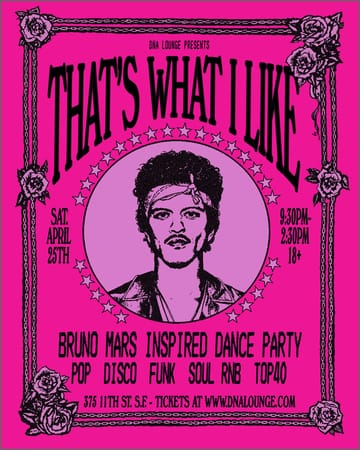
I hear Spotify is the new hotness, let's see if they will take our money:
Ad name: DNA Lounge Bruno Mars Party Your ad wasn't approved for the following reasons: Reason: Your ad contains only music. Recommendation: Submit a new ad with a clear voiceover that explains what's being advertised.
Do you want TikTok AI Voice? Because this is how you get TikTok AI Voice.
a) apple agriculture b) suburban folk horror c) cults
Then boy howdy do I have a book for you — Black River Orchard is just shy of two bucks on your favorite electromagic bookreaderplatformbuyer, which is to say, “wherever you buy your e-books.”
It’s a book I’m quite proud of! So go try it out if you haven’t. Tell everyone. *cue Gary Oldman in The Professional* EVVVVERRRRYOOOONNNNE
Also a reminder that The Staircase in the Woods is out in paperback now, and The Calamities launches in August, and you can preorder at Doylestown Bookshop for a bunch of goodies and unique personalizations where I personally name your DEMONIC PROGENITOR allllll for you, Damien. All for you. I’m working with an artist whose name might rhyme with Matalie Netzger to do some more cool sticker art stuff too.
Oh! And if you haven’t seen the Calamities cover under the cover…
Cosmic Crowns Designer: Alessio Convito, Michael Hale Publisher: Sumain Games Players: 2-5 Age: 10+ Time: 30 minutes Amazon affiliate link: Played with review copy provided by publisher Play an easy-to-learn cosmic card battle. Command a mix of four … Continue reading →
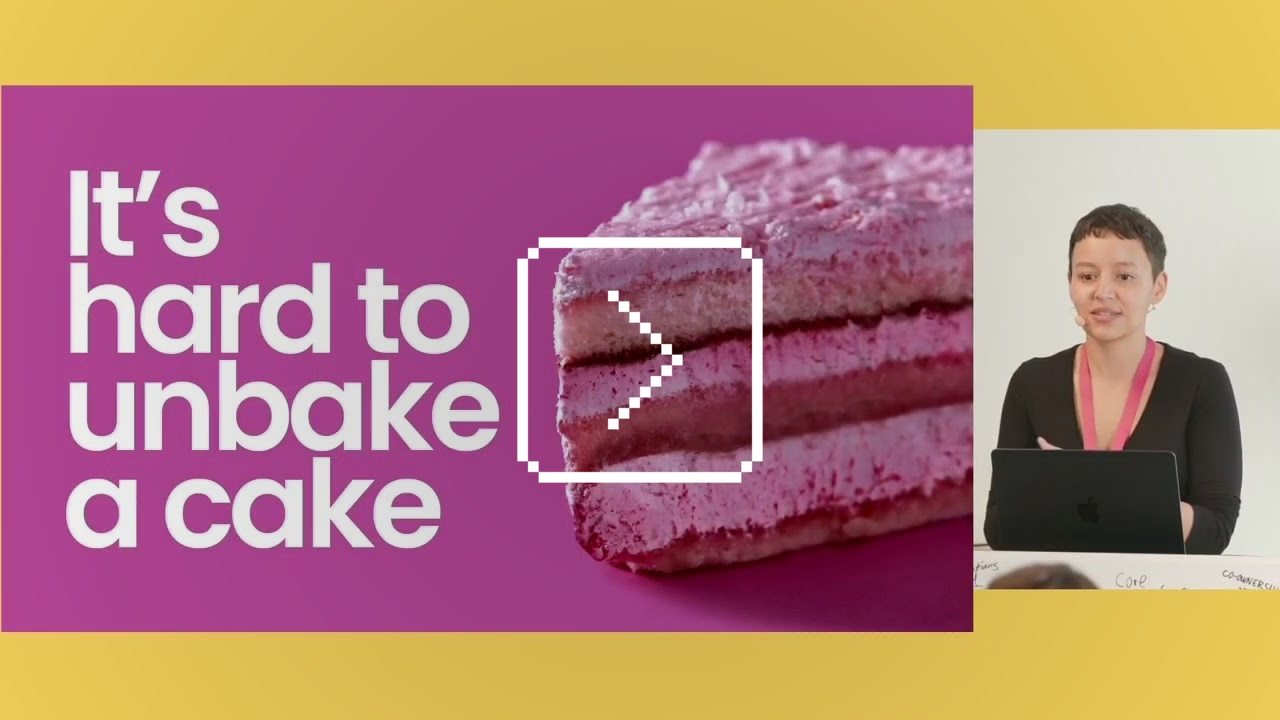
A thoughtful 26-minute talk by Imani Joy, the solitary full-time designer on Mastodon, reflecting on her nine months there:
It’s an interesting peek behind the curtain at designing for this particular space, and the many unenviable constraints: lack of data, care for privacy, tension between Mastodon’s power-user early adopters (“they are values-driven, they want control, they’ll tolerate a lot of the clunkiness of the Fediverse”) and “mainstream audience [that] expects polish.”
At some point, design needs to be authoritative, but how do you combine that with wanting the process to be as inclusive as possible? The product itself is a federation of various servers that can exert their own control – so how do you bring it all together under one neat umbrella for the user? (Also a challenge for Android in comparison with iOS.) The mainstream design has certain fashion-y tendencies. How to make sure you don’t lose yourself while chasing them, but also not to stay ossified out of fear of making changes? (Wikipedia, Internet Archive, and other similar places look and behave a certain way, after all, and it’s not usually because of lack of talent to “modernize” them.)
The most interesting thing to me was this:
It’s easy to talk in terms of who to optimize for. Things get harder when you start to articulate who you won’t optimize for, what trade-offs you must make in pursuit of your goal, and who you’re going to risk letting down along the way. What the team needed from me more than anything was not the probabilities, not the usability findings, not the story of who we’re making happy. They needed to hear who will choose to disappoint and why. And I told them that building the best experience on Mastodon means that we’ll solve for the extremes, but we won’t center them. And sure, we do risk frustrating some power users who want absolute control over their profiles, but that risk is necessary to optimize the experience also for browsing users.
When we were working at Figma in 2019 shipping an update to text line height algorithms (moving them from the way print does things to the way web does things), I started an internal document called “The new line height and its discontents,” where myself and the team deliberately wrote out who will be most annoyed about the changes, and why. We listed our arguments, workarounds, even “deal sweeteners” (“but look at this other thing that will get better as a result!”), but we also tried very hard to be candid with ourselves. Some people were not going to be happy no matter what we do or say. Do we know precisely who these people are and are we okay with that? I’d recommend that approach for any change-management project, rather than keeping fingers crossed or toxic positivity.
Joy so far worked on quote posts and new profiles, and I appreciated her ending the talk on a note of recognition for these kinds of projects in these kinds of settings:
I know that we’re building something that will continue to be imperfect, but it doesn’t have to be perfect to make a positive difference in the world.
I'm leading another library discussion April 16. This one is a pleasant middle-aged romance / comedy of manners in a 2010 British village (caveat: some family drama). Must have Zoom account (free is fine) to join (don't have to be local)!
I enjoyed this book over a decade ago and went to hear the author, Helen Simonson, talk about it back then at the Bethesda library. The part I remember most is she wanted to put an elephant in it (the big banquet scene) and her editor said no. Sometimes editors are right. Anyway, I have a hold on the audiobook but it's a 6-week wait. If I have to, I'll get the ebook from Libby, or the print book from the library, to refresh my memory. I may not come up with my own questions this time, since there are two reasonable discussion guides online (I don't agree with the assumptions in all of them, but they're reasonably phrased and can spur discussions either way).
Though the Netflix app is largely the same on most platforms, over
the weekend several Apple TV users on the unofficial Apple TV
Reddit noticed some small changes to the tvOS version of
the app that are making the app harder to use in subtle but very
frustrating ways.
According to user iamonreddit, the most recent Netflix app
update has made it slightly more difficult to use the fast-forward
and rewind functions. Instead of clicking the back or forward
button on the remote wheel to advance or return ten seconds, this
button press now pauses the screen and brings up a frame selector.
In order to actually go forward or go back, users then have to
click the same button again. So essentially, what once required a
single button press, now needs two.
These changes aren’t small, aren’t subtle, and don’t make fast-forwarding and rewinding merely “slightly” more difficult. (And what once required a single button press now requires three, not two.) The video playback interface in a streaming app is the most essential thing a streaming app does, and now Netflix’s tvOS player looks terrible and works wrong. The original report Kondolojy cites, from Reddit user “iamonreddit” (yes, you are), describes it as it is:
Did Netflix mess up the app? There are two extra clicks for a
simple 10s rewind or fast forward. Instead of it going back 10s in
one click, now it pauses and brings up the frame selector, and
then you have to click again. Did they not do any research or
usability testing before releasing this?
It’s also not smooth at all, it keeps spinning for a while and I
have 1gig fiber optic internet. What a big downgrade!
They have some of the top paid employees in the world and this is
what they come up with. Unless this was the result of some
restrictions introduced by Apple.
Looks like they messed it up big time. Netflix used to set
benchmarks for others. And here we are now. I’ve never had a
single problem with their app so for, for over a decade of use.
Netflix’s gratuitously ugly new custom video player commits various crimes against accessibility. Two years ago I wrote about tvOS’s system accessibility shortcut that lets you assign triple-clicking the Back (“<”) button to toggle captions, and the fact that Netflix didn’t support it. This cursed new player, you will be unsurprised to learn, doesn’t support it either. It also does not support the wonderful standard platform convention of temporarily turning on captions when you rewind 10 or 20 seconds, for a “What did they just say?” moment.
Update: Switching to their own custom video player also broke Netflix’s integration with the iPhone. Until last week, playing video in the Netflix app on Apple TV would put a live activity widget on your iPhone lock screen with the name of the current program, scrub location, and player controls. Now that’s gone.
This regression dropping the same week that Netflix announced price hikes makes me so angry that I’m giving even more thought to downgrading my family’s Netflix account from the $27/month Premium plan to the $20/month Standard plan. Sending Netflix only $240 per year instead of $324 will show them.
President Trump’s signature will appear on U.S. dollars later this
year, the Treasury Department said on Thursday. The decision to
have Mr. Trump’s John Hancock on America’s paper currency
represented an unprecedented change, one that the department said
was being made in honor of the United States’ 250th anniversary.
Mr. Trump is set to become the first sitting U.S. president to
have his signature on the greenback. His name will appear
alongside that of Treasury Secretary Scott Bessent. As a result,
the U.S. treasurer, whose name has been on the currency for more
than a century, will not appear on the currency.
Trump’s signature will go on the bills in honor of the country’s
250th anniversary, the Treasury said. Historically, paper currency
carries the signatures of the treasury secretary and the
treasurer.
“The President’s mark on history as the architect of America’s
Golden Age economic revival is undeniable,” Treasury Secretary
Scott Bessent said in a statement. “Printing his signature on the
American currency is not only appropriate, but also well
deserved.”
It’s certainly news that the sitting president — a man whom psychologists have publicly described as showing clear “symptoms of severe, untreatable personality disorder — malignant narcissism” — is putting his signature on U.S. currency. But why parrot the administration’s obviously false line that this gross, embarrassing change in longstanding tradition has anything whatsoever to do with “honoring” the United States’s 250th anniversary?
It makes no more sense that putting Trump’s signature on greenbacks “honors the nation” or its history than it would to claim that doing so will cure the common cold, reverse male pattern baldness, or keep us safe from Bigfoot. Call it what it is: sycophantic ego fellatio for a deeply unpopular narcissist who is losing his already tenuous grip on reality.
The New York Post (I’m not sure if I should tell you to take this with a grain of salt, because it’s the Post and their journalistic standards are low, or, to assign this extra credibility because it’s the Post, a right-wing Murdoch rag that Trump lackeys actually talk to):
President Trump is prioritizing taking control of the Strait of
Hormuz as he grows frustrated with the lack of help from allies to
force open the crucial waterway. And once Trump ends Iran’s reign
of terror over the shipping route, he’s considering rechristening
it the “Strait of America” or even naming it after himself,
sources told The Post. [...]
Trump told a Saudi investor forum Friday evening in Miami that he
might decide to call the Strait after himself, rather than
America.
“They have to open up the Strait of Trump — I mean Hormuz,” Trump
said. “Excuse me, I’m so sorry. Such a terrible mistake. The Fake
News will say, ‘He accidentally said.’ No, there’s no accidents
with me, not too many.”
I suspect there are going to be accidents soon, as he descends further into dementia and needs adult diapers.
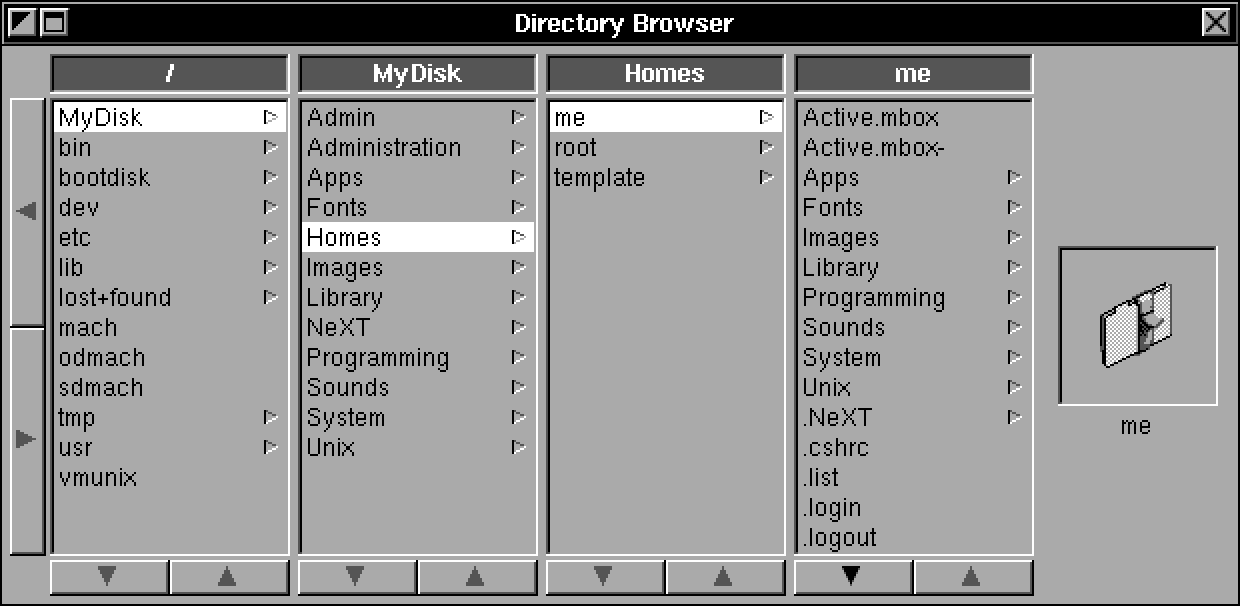
…but where I thought it really shone was the first iPods:
This was perhaps the most fun you could ever have navigating a hierarchy of things; it made sense what left/right/up/down meant in this universe, to a point you could easily build a mental model of what goes where, even if your viewport was smaller than ever.
It was also a close-to-ideal union of software and hardware, admirable in its simplicity and attention to detail. This is where Apple practiced momentum curves, haptics (via a tiny speaker, doing haptic-like clicks), and handling touch programmatically (only the first iPod had a physically rotating wheel, later replaced by stationary touch-sensitive surfaces) – all necessary to make iPhone’s eventual multi-touch so successful. And, iPhone embraced column views wholesale, for everything from the Music app (obvi), through Notes, to Settings.
Well, sometimes you don’t appreciate something until it’s taken away. Here are settings in the iOS version of Google Maps:
I am not sure why the designers chose to deviate from the standard, replacing a clear Y/X relationship with a more confusing Y/Z-that-looks-very-much-like-Y. They kept the chevrons hinting at the original orientation – and they probably had to, as vertical chevrons have a different connotation, but perhaps this was the warning sign right here not to change things.
I think the principle is, in general: if you’re reinventing something well-established, both of your reasoning and your execution have to be really, really solid. I don’t think this has happened here. (Other Google apps seem to use standard column view model.)
![[syndicated profile]](https://www.dreamwidth.org/img/silk/identity/feed.png) dumbing_of_age_feed
dumbing_of_age_feed


![[personal profile]](https://www.dreamwidth.org/img/silk/identity/user.png)